
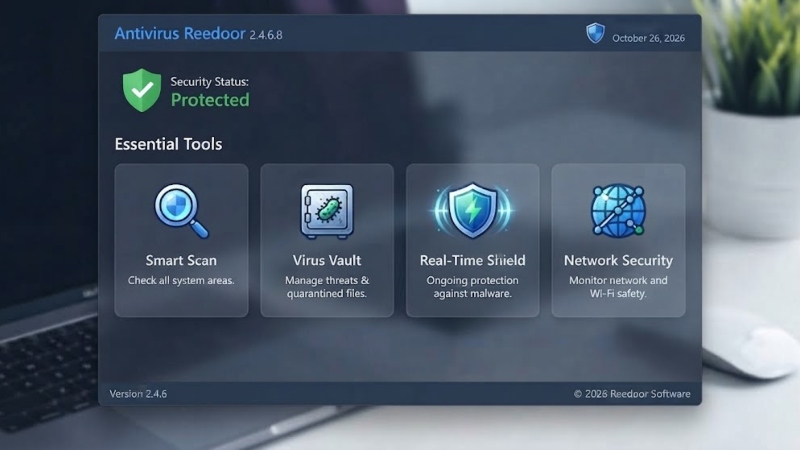
When people search for antivirus reedoor2.4.6.8, they are often trying to understand an unfamiliar name connected with Windows, antivirus warnings, or a strange error. The problem is that information about this term is not consistent.
Some websites describe Reedoor2.4.6.8 as antivirus software. Others connect it with Windows errors, system files, or suspicious alerts. However, there is no clearly verified software company, official product page, or Microsoft documentation that establishes Reedoor2.4.6.8 as a recognized Windows security product.
That means the safest approach is not to assume what the name means. Instead, you should first find out where Reedoor2.4.6.8 appeared on your computer.
What Is Reedoor2.4.6.8?
Reedoor2.4.6.8 is an unverified software-related term that appears in online searches and articles. There is currently no strong public evidence connecting it to an established antivirus company or an official Windows component.
The number sequence, 2.4.6.8, looks like a normal software version. However, a version number by itself does not prove that a program is legitimate.
Real software normally has information such as:
- A verified developer or publisher
- An official website
- Product documentation
- Release notes or changelogs
- A legitimate download source
- Support information
- A consistent product name
Available information about Reedoor2.4.6.8 does not provide that same level of verification. Recent pages discussing the term also disagree about what it actually represents.
Is Reedoor2.4.6.8 a Real Antivirus?
There is no reliable evidence that Reedoor2.4.6.8 is an established antivirus product.
Some online articles use phrases such as “Antivirus Reedoor2.4.6.8” and describe it as security software. However, those descriptions do not establish a verified security vendor behind the product. Other pages describe the same name as an error, system identifier, or suspicious program.
This difference matters.
A real antivirus product should be easy to trace to its developer. For example, Windows includes Microsoft Defender Antivirus through Windows Security, and Microsoft provides official documentation for its security features. Windows Security also provides scanning and protection tools for viruses, malware, and ransomware.
Therefore, you should not treat Reedoor2.4.6.8 as a trusted antivirus simply because a website calls it one.
What Is “Reedoor2.4.6.8 Data Error”?
The phrase “reedoor2.4.6.8 data error” appears to be another search variation connected with this unusual term.
There is no verified Microsoft error code or official Windows error documentation establishing “Reedoor2.4.6.8 data error” as a standard Windows error.
This is important because an unfamiliar error message can have several possible causes. The name might belong to:
- A third-party application
- A browser notification
- A file or process
- An installed program
- An internal identifier
- A misleading online alert
- A corrupted or missing file
Without seeing the original error message, it would be incorrect to claim that one specific problem causes every Reedoor2.4.6.8 error.
So if you see a Reedoor2.4.6.8 data error, first identify the application or process that generated it.
What Is Data Reedoor2.4.6.8?
The phrase data reedoor2.4.6.8 does not have a clearly established technical meaning in official Windows documentation.
Some online articles connect the phrase with data problems, system errors, or security issues. However, these descriptions should be treated carefully because the sources do not provide a consistent technical definition.
In simple terms, there is not enough verified information to say that “data reedoor2.4.6.8” is a specific Windows data system, database, or Microsoft technology.
If the phrase appears in a file, error message, or application, the surrounding information is much more useful than the keyword alone.
For example, check:
- The name of the application showing the message.
- The exact error text.
- The file path.
- The time when the error appeared.
- Whether you recently installed new software.
- Whether Windows Security detected anything.
These details can help identify the actual problem.
What Is Reedoor2.4.6.8 for Windows?
If you are searching what is reedoor2.4.6.8 for Windows, the safest answer is that it is not a verified Microsoft Windows component or a recognized built-in Windows security feature.
Microsoft documents Windows security components and provides official tools for checking threats and system problems. Reedoor2.4.6.8 does not have the same type of official documentation.
This does not automatically prove that every file carrying this name is malware. A strange name alone is not enough to identify a malicious file.
Instead, look at where the name came from.
If you only saw it in a web article, there may be nothing installed on your computer.
If you saw it in an unexpected pop-up, the situation is different.
If you saw it as a running process or installed application, you should investigate the actual file.
Why Does Reedoor2.4.6.8 Look Like a Software Version?
The format 2.4.6.8 resembles a software version number.
Many legitimate programs use numbers to identify different releases. For example, developers may change a version number after adding features, fixing bugs, or improving security.
But the format itself does not prove anything.
Anyone can create a name that looks like a software version. That is why you should always look for the company behind the software and its official documentation instead of trusting the number.
A version number without a verifiable publisher or release history should be treated as an identifier that needs further investigation.
What Should You Do If You See Reedoor2.4.6.8?
The correct action depends on where you saw the name.
If You Saw It in a Browser
Do not immediately download anything recommended by the warning.
Some websites use alarming notifications to convince visitors that their computers have security problems. If the message appeared as a browser notification, close the page and review the notification permissions for unfamiliar websites.
If You Saw It in an Antivirus Alert
Open your antivirus software directly instead of clicking the warning.
If you use Windows Security, check Protection History. Microsoft says this area records actions taken by Microsoft Defender Antivirus, including malware detections and potentially unwanted applications.
Look for:
- Threat name
- File location
- Detection date
- Action taken
- Whether the item was quarantined
This information is much more useful than searching the unfamiliar name alone.
If You Saw It in Task Manager
Open Task Manager and check whether a process with a similar name is running.
Do not immediately delete system files simply because their name looks unfamiliar.
Instead, check the file location and publisher information. An unusual process name does not automatically mean malware.
If You Saw It in Installed Apps
Open the Windows installed apps list and look for the program.
Check the publisher and installation date. If you do not recognize the program, investigate it before removing it.
If a Website Tells You to Download It
Be cautious.
Do not install unknown antivirus software from a random website simply because a page says your computer is infected.
A legitimate security product should have a traceable developer and an official distribution channel.
How to Check Your Windows PC Safely
Windows Security already provides several tools for investigating possible threats.
Open Windows Security and go to Virus & threat protection.
You can check current threats, review recent scans, and start different types of scans. Microsoft also provides Quick Scan, Full Scan, Custom Scan, and Microsoft Defender Offline Scan options.
If you suspect that an unknown file is present, a Full Scan can provide a broader check of the system.
Do not disable your antivirus just because an unfamiliar program tells you to do so.
Can SFC or DISM Fix a Reedoor2.4.6.8 Data Error?
It depends on the actual cause of the error.
If the problem is caused by damaged Windows system files, built-in Windows repair tools can help. Microsoft documents System File Checker (SFC) as a utility that checks protected Windows resources and can repair certain corrupted system files.
Microsoft also documents DISM commands for repairing Windows image corruption. For supported Windows versions, the following command can be used from an elevated Command Prompt:
DISM.exe /Online /Cleanup-image /RestorehealthAfterward, you can run:
sfc /scannowMicrosoft recommends these tools for certain Windows corruption and update-related problems.
However, these commands should not be treated as a guaranteed solution for every Reedoor2.4.6.8 data error. If the message comes from an unrelated third-party application, repairing Windows system files may not fix it.
Is Reedoor2.4.6.8 a Virus?
The name alone cannot prove that it is a virus.
This is an important distinction.
Some websites currently describe Reedoor2.4.6.8 as suspicious or connect it with scareware. Other pages present different explanations. Because there is no clearly verified product identity, it would be misleading to call every appearance of the name malware without examining the actual file or alert.
If Windows Security detects an actual file, rely on the detection details and file location rather than the name found in a random article.
How to Avoid Fake Antivirus Warnings
You can reduce the risk of misleading security alerts by following a few simple habits.
Do not trust urgent pop-ups. A webpage cannot automatically prove that your computer has a virus just because it displays a warning.
Download security software from official sources. Avoid installers offered through random advertisements or unfamiliar websites.
Keep Windows updated. Security updates can help protect your system against known vulnerabilities.
Check the publisher. Unknown software deserves additional investigation before installation.
Use Windows Security. It provides built-in tools for scanning and reviewing security events on supported Windows versions.
Reedoor2.4.6.8: What We Actually Know
The most important fact is that Reedoor2.4.6.8 does not currently have a clearly verified identity as an official Windows component or established antivirus product.
The terms antivirus reedoor2.4.6.8, reedoor2.4.6.8 data error, data reedoor2.4.6.8, and what is reedoor2.4.6.8 for Windows appear in online discussions, but the available descriptions are inconsistent.
That means readers should avoid treating detailed claims about its features, performance, security rating, or developer as confirmed facts unless those claims can be traced to a reliable primary source.
If you see the name on your computer, focus on the context: where it appeared, which program generated it, and what file or alert is connected to it.
Conclusion
Reedoor2.4.6.8 is an unusual and poorly documented software-related term. Current online sources do not establish it as a recognized Windows antivirus or official Microsoft component.
The safest approach is simple: do not download or pay for software simply because a website uses the Reedoor2.4.6.8 name. First, identify the source of the message or file. If there is a genuine security alert, check it through Windows Security and review Protection History.
Most importantly, do not confuse an unfamiliar name with proof of infection. The actual file, publisher, location, and security detection are what matter.
Frequently Asked Questions
What is Reedoor2.4.6.8?
Reedoor2.4.6.8 is an unverified software-related term found in recent online content. There is no clear evidence that it is an official Microsoft Windows component.
Is Reedoor2.4.6.8 an antivirus?
There is no reliable evidence establishing it as a legitimate antivirus product from a recognized security company.
What does Reedoor2.4.6.8 data error mean?
The phrase does not have a clearly documented meaning in official Windows sources. Its cause depends on the application, file, or process that generated the message.
What is Reedoor2.4.6.8 for Windows?
It is not a recognized built-in Windows component based on the available official documentation. If you see the name on your computer, investigate where it came from before taking action.
Should I download Reedoor2.4.6.8?
Do not download an unknown program simply because an online page recommends it. Verify the publisher and official source first.
How can I check if my PC has a real security problem?
Open Windows Security and check Virus & threat protection and Protection History. These tools can show detected threats and actions taken by Microsoft Defender Antivirus.
Can SFC fix the problem?
SFC can check and repair certain protected Windows system files, but it will not necessarily fix an error caused by an unrelated third-party application.
Conclusion
The keyword reedoor2.4.6.8 may look like the name of a technical product, but the available evidence does not establish a clear and trustworthy identity behind it.
Instead of trusting a random description, check the original source of the term on your computer. This simple step can help you separate a genuine Windows problem from a misleading notification, an unknown application, or an internet search term.
When dealing with antivirus-related warnings, careful verification is always better than downloading an unfamiliar program in a hurry.