
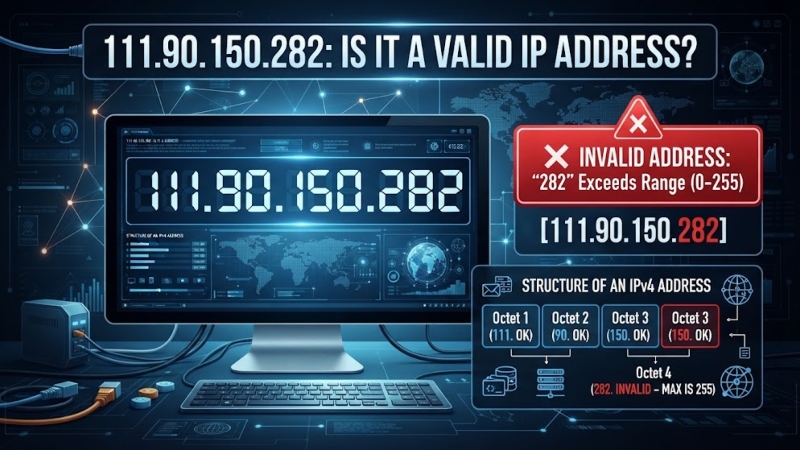
If you have come across 111.90.150.282, you may assume that it is a normal internet IP address. At first glance, it looks like a standard IPv4 address because it contains four numbers separated by dots.
However, there is a simple technical problem with it.
111.90.150.282 is not a valid IPv4 address. The last number, 282, is higher than the maximum value allowed in an IPv4 address.
This guide explains why the address is invalid, what the numbers mean, and what you should do if you find it in a log, message, document, or configuration.
What Is 111.90.150.282?
The sequence 111.90.150.282 looks like an IPv4 address.
IPv4 addresses normally contain four numerical sections separated by periods. Each section is called an octet.
For example:
192.168.1.10
Each number in a normal IPv4 address must fall between 0 and 255.
The problem with 111.90.150.282 appears in the final section.
The number 282 exceeds 255, so the complete address does not meet the standard IPv4 format.
Why Is 111.90.150.282 Invalid?
The reason is straightforward.
An IPv4 address contains four 8-bit octets. An 8-bit value can represent numbers from 0 through 255.
Here is the breakdown:
| Section | Value | Valid? |
|---|---|---|
| First | 111 | Yes |
| Second | 90 | Yes |
| Third | 150 | Yes |
| Fourth | 282 | No |
The first three numbers are within the accepted range.
The final number creates the problem.
Because 282 is greater than 255, the entire sequence is invalid as a conventional IPv4 address.
What Is an IPv4 Address?
An IPv4 address helps identify a network interface and allows devices to communicate across IP networks.
The format uses four octets:
A.B.C.D
Each octet has a possible value from 0 to 255.
For example:
- 8.8.8.8
- 1.1.1.1
- 192.168.1.1
- 10.0.0.1
These examples follow the basic IPv4 numerical format.
By comparison, 111.90.150.282 breaks the rule because its final octet contains a value above 255.
Does 282 Have a Special Meaning?
Not as the fourth octet of a standard IPv4 address.
Someone might see 282 and assume that it represents a special server number, port, location, or security code. The number itself does not establish any of those meanings.
Without additional context, it is simply the invalid final portion of an IP-like string.
It is therefore better not to connect this sequence with a particular server, person, country, or cybersecurity incident without independent evidence.
Could 111.90.150.282 Be a Typo?
Yes.
A typing or copying mistake is one possible explanation.
For example, someone might have intended to enter another value below 256 but accidentally typed 282.
This can happen when people manually copy technical information from:
- Emails
- Screenshots
- Documents
- Server logs
- Configuration files
- Chat messages
- Online posts
If you found this sequence somewhere, check the source before assuming that it represents a real IP address.
Can You Connect to 111.90.150.282?
A standard networking tool should not treat 111.90.150.282 as a valid IPv4 destination.
The invalid octet prevents the address from meeting normal IPv4 formatting requirements.
If you are troubleshooting a connection and this address appears in your configuration, review the original value carefully.
Do not randomly replace the final number with another value unless you know what address the system actually requires.
Is 111.90.150.282 Dangerous?
The sequence itself does not prove that malware, hacking, or another security threat exists.
In fact, because 111.90.150.282 is not a valid IPv4 address, you should not treat it as evidence of a specific internet-connected device.
Some websites currently discuss the keyword as an unusual or invalid IP-like sequence, but those discussions do not establish that the number belongs to a particular attacker or malicious server.
The surrounding context matters much more.
For example, if you found the number inside a suspicious email, the email itself may deserve investigation. The invalid IP format alone does not tell you who created it or why.
What If You Found It in a Server Log?
If 111.90.150.282 appears in a log, do not immediately assume that the log contains a genuine source IP.
First, check how the application recorded the value.
Possible explanations include:
- A malformed input
- A data-entry mistake
- A parsing problem
- A copied value
- A test value
- An application logging issue
- An incorrectly formatted identifier
Look at the surrounding entries and timestamps.
If other valid IP addresses appear in the same log, compare their format with the unusual value.
How to Check an IP Address Yourself
You do not need advanced networking knowledge to perform a basic format check.
Follow these steps:
Count the Sections
A standard IPv4 address should have four numerical sections.
For example:
111.90.150.282
contains four sections.
So far, the format looks correct.
Check Every Number
Now check each section.
The first three values—111, 90, and 150—fall within the accepted range.
The final value, 282, does not.
Confirm the Source
If the address came from a document, email, log, or website, return to that source.
Look for a nearby explanation or another version of the address.
Do Not Guess the Correct Value
If the original number contains a mistake, don’t simply change it to a number that looks right.
The correct value depends on the original network or system.
IPv4 and IPv6 Are Different
It is also useful to understand that 111.90.150.282 looks like IPv4, not IPv6.
IPv4 uses four decimal octets separated by periods.
IPv6 uses a different format and normally contains hexadecimal characters separated by colons.
For example, an IPv6 address may look very different from:
111.90.150.282
Therefore, the IPv4 range rule applies when evaluating this particular sequence.
What Should You Do If You See This Address?
The right action depends on where you found it.
A random article may use it simply as an example of an invalid IP-like string.
When it appears in your own network configuration, check the settings for a typing error.
For a log entry, review the surrounding records to see whether the application treated the value as text instead of a valid IP address.
A suspicious message should be reviewed as a whole rather than assuming that this number identifies the sender.
Common Mistakes to Avoid
Assuming Every Four-Part Number Is a Valid IP
Four numbers separated by dots do not automatically create a valid IPv4 address.
Every section must also meet the numerical range requirement.
Treating 282 as a Valid Octet
The maximum IPv4 octet value is 255, not 282.
Assuming the IP Reveals a Hacker
An unusual IP-like string does not identify a hacker or cyberattack by itself.
You need additional evidence before making that conclusion.
Changing the Address Without Checking
If you think 111.90.150.282 contains a typo, don’t randomly change 282.
Check the source first.
Quick Facts About 111.90.150.282
| Detail | Information |
|---|---|
| Format | IPv4-like |
| First octet | 111 |
| Second octet | 90 |
| Third octet | 150 |
| Fourth octet | 282 |
| Valid IPv4? | No |
| Main issue | Fourth octet exceeds 255 |
| Possible explanation | Typographical or malformed value |
| Confirmed malicious? | No evidence from the IP-like string alone |
Final Verdict
111.90.150.282 is not a valid standard IPv4 address.
The first three octets are acceptable, but the final octet, 282, exceeds the IPv4 limit of 255. That single value makes the complete address invalid.
If you found this sequence online, in a log, or in a technical document, the best approach is to check the original context.
Do not automatically assume that it represents a real server, a hacker, or malware.
In most practical situations, the first thing to investigate is whether someone entered, copied, or generated the value incorrectly.
FAQs
Is 111.90.150.282 a real IP address?
No. It does not meet the standard IPv4 range requirements because its final octet is 282.
What is wrong with 111.90.150.282?
The fourth octet is 282, while a valid IPv4 octet can only range from 0 to 255.
Can 111.90.150.282 identify a real server?
Not as a standard IPv4 address. The format itself is invalid.
Is 111.90.150.282 a dangerous IP?
The string alone does not prove that it is dangerous or connected to malicious activity.
Could 111.90.150.282 be a typo?
Yes. A typing, copying, parsing, or formatting error could produce an invalid IP-like sequence.
What should I do if I find it in a log?
Check the surrounding log entries, the application that created the log, and the original source of the value. Do not assume that the entry represents a valid source IP.